
Language: English
-

GitHub-related roles – onboarding for WordPress Documentation team
Speaker: Milana CapFebruary 8, 2023 — Recorded February 2023 onboarding session for WordPress Documentation Team roles: Issue triage facilitator, Issues coordinator, and Issues reviewer.
-

Creating a photography website with the block editor
Speaker: Wes TheronFebruary 7, 2023 — In this Online Workshop, we will look at how you can use the block editor, and blocks, to create a photography website to display your images and photographic skills. I will demo how I created my own site using the Twenty Twenty-Three theme.
-

Let’s code: WP REST API – modifying responses
Speaker: Jonathan BossengerFebruary 3, 2023 — The WordPress REST API provides an interface for applications to interact with your WordPress site by sending and receiving data as JSON (JavaScript Object Notation) objects. By default, it provides REST endpoints (URLs) representing the posts, pages, taxonomies, and other built-in WordPress data types. Your application can send and receive JSON data to these endpoints to query, modify and create content on your site. However, it is also possible to extend the WP REST API, in order to perform specific actions that are outside of the scope of the default routes and endpoints. In this session, you will learn about one of the ways you can extend the WP REST API, by modifying REST responses.
-

Introduction to securely developing plugins
Speaker: Jonathan BossengerFebruary 3, 2023 — With WordPress now powering over 40% of the web, website owners need to think more about online security. Almost every week a new plugin vulnerability is found and patched, leading to concerns about the security of WordPress.
Fortunately for the new plugin developer, the WordPress developer handbook has an extensive section on Plugin Security. If followed, plugin vulnerabilities can be drastically reduced, and the entire ecosystem is protected.
This tutorial will introduce the new developer to the first 5 areas of plugin security, using easy-to-understand examples.
-

WordPress Through The Terminal
WordPress Through The TerminalSpeaker: Milana CapFebruary 2, 2023 — Remember the famous “5 minutes installation” process for installing WordPress? Let’s see what WP-CLI can do in 5 minutes, and everything else that can happen in the terminal in 40 minutes. We might actually make WordPress instances more secure. Or just break it.
This is not your usual presentation talk, it is a live terminal commanding demonstration; SSHing your WordPress administration and development; and releasing the Kraken or two.
-

Let’s make custom templates in the Site Editor!
Speaker: Benjamin EvansFebruary 2, 2023 — The WordPress Site Editor offers users to create Custom Templates that can be used on any page or post. In this Online Workshop, we’ll demonstrate creating multiple post templates and assigning them to different types of posts within the same site/blog.
-
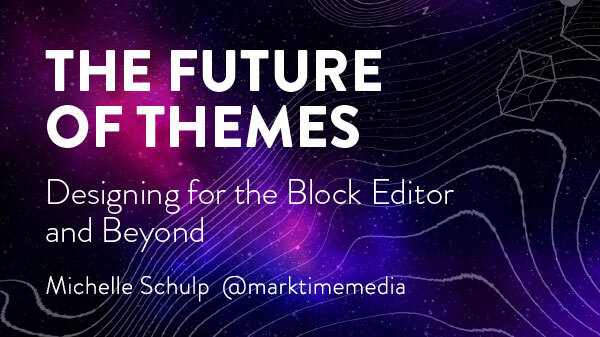
The Future Of Themes: Designing for the Block Editor and Beyond
The Future Of Themes: Designing for the Block Editor and BeyondSpeaker: Michelle SchulpJanuary 30, 2023 — When designing WordPress themes, one of the biggest challenges stems from a core component of WordPress itself: the ability for site owners to change, modify, and build new content themselves. This simple yet powerful capability was a driving force behind the adoption and popularity of WordPress, but theme designers are faced with a difficult task: designing for content and functionality that doesn’t yet exist.
As content and functionality become even more modular thanks to advances like the block editor, and as we look ahead to the adoption of Full Site Editing, theme designers will have to accommodate even more flexible ways of visualizing and presenting the information. How do we anticipate and accommodate the needs of a constantly evolving website while providing visual solutions that are clean, thoughtful, and consistent?
We will walk through the entire design thinking process as it relates to themes, and you’ll leave with a thorough checklist of steps and tools for designing themes that support WordPress core functionality, custom templates and content, common plugins, and an array of standard and custom Gutenberg blocks. This process is useful both for custom theme builds, and designing themes for sale as a product.
-

Let’s code: WP REST API updates, custom fields, and authentication
Speaker: Jonathan BossengerJanuary 27, 2023 — In this session, we will continue to learn how to use the WP REST API and Backbone.js client by looking at how to make update requests, how to add or update custom fields on posts, and how to authenticate REST API requests when not logged into a WordPress site.
At the same time, we’ll review how to use the Postman API testing tool to test our WP REST API Requests
-

Using theme.json with classic themes
Speaker: Jonathan BossengerJanuary 27, 2023 — The theme.json is a file that allows block theme developers to control the settings and styles of the blocks in the Editor.
In this video, you’re going learn what happens when you add a theme.json file to a classic theme.
-

Patterns, Reusable Blocks and Block Locking
Speaker: Wes TheronJanuary 24, 2023 — In this Online Workshop, we will explore using block patterns, creating and editing reusable blocks and utilising the block locking feature.

An  Joint
Joint
