
Language: English
-
Tyler Golberg: Getting in your audience’s shoes
WordCamp Phoenix 2018Speaker: Tyler GolbergFebruary 26, 2018 — Far too often we build website from our own perspective. Putting yourself in your audiences’ shoes is much easier said than done. We’ll take a look at how visitors view your website and how to turn their frustrations into success.
-
Kerry Carron: Do More Than Survive as a Freelancer
WordCamp Albuquerque 2018Speaker: Kerry CarronFebruary 26, 2018 — Balancing life as a freelancer in the real world. From surviving to thriving in business, relationships, and health.
Note: due to an operations glitch we did not have video for this presentation, so we’re paired the slides with the audio.
-
Steve Zehngut: How To Run a Successful WordPress Agency
WordCamp Phoenix 2018Speaker: Steve ZehngutFebruary 26, 2018 — Zeek Interactive has been a successful agency since 1995. Steve will share his stories and tips for managing client expectations, strategies for proper communication and thoughts on how to motivate a team. This session applies to everyone from freelancers to agencies.
-
Sheila Hoffman, Dashon Hawkins: Imposter Syndrome: Stories from Two Different Perspectives
WordCamp Phoenix 2018Speakers: Sheila Hoffman, Dashon HawkinsFebruary 26, 2018 — Imposter Syndrome affects minorities and Women in Tech at a much higher rate than in other professions. Dashon Hawkins and Sheila Hoffman will share their own experience on this important topic.
-
Daniel Schutzsmith: Design Patterns with Advanced Custom Fields and WordPress
WordCamp Albuquerque 2018Speaker: Daniel SchutzsmithFebruary 26, 2018 — Amnesty International USA launched a website redesign in May 2017 based on a six month journey of defining a design pattern that would reinforce our branding and making it easy to implement on any page of our website using WordPress, Bootstrap 4 and Advanced Custom Fields. We’ll take a look at the journey of defining the design patttern and why it’s important for every website to have one. Then we’ll explore how ACF uses Flexible Content and Repeater fields to create an infinite amount of design possibilities while still remaining within a brands aesthetic design guidelines. Code, design and process will be shared.
-
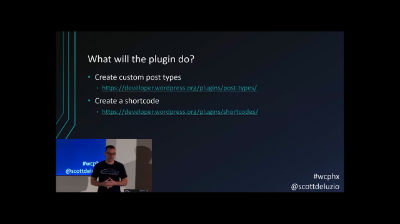
Scott DeLuzio: Building Your First Plugin – A Complete Newbie’s Guide to Creating a Plugin
WordCamp Phoenix 2018Speaker: Scott DeLuzioFebruary 26, 2018 — This talk will cover everything you need to know in order to create a plugin to start using on your own site. You won’t need to have any prior PHP or other coding knowledge to walk away with something you can use right away.
-
Mike Demo: Which Way Does Your Duck face?
WordCamp Phoenix 2018Speaker: Mike DemoFebruary 26, 2018 — Do you know that if you have a picture of a duck having it face left or right can increase your conversions by 40%?
Think this sounds silly? It is but backed by research. Spend some time to learn about what a/b testing is, what things to test, testing methodology and the best tools to use for your site.
Everyone will get a handout of the very same checklist I use when A/B testing our client’s sites. One of our clients, an insurance company, increased leads by making just a small 2px change.
When you launch a website, you are guessing. Sure the guesses are educated based on experience and data, but you can maximize your ROI with good A/B testing.
-

Aaron D. Campbell: Why the Open Web Matters
WordCamp Phoenix 2018Speaker: Aaron D. CampbellFebruary 26, 2018 — The internet is the single most effective information sharing tool in all of history. We can build on the work and progress of others in a completely unprecedented way. The implications for the progress of humanity are both serious and exciting!
But it’s also in danger. Find out why I think open systems and the open web will steer our future or how the lack of them will ruin it.
-
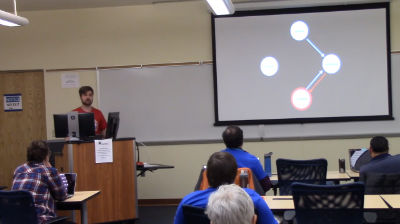
Dennis Snell: Help! There’s Too Much Spaghetti in My APIs
WordCamp Albuquerque 2018Speaker: Dennis SnellFebruary 26, 2018 — In this talk we’re specifically going to look at how a combination of REST principles and modeling our processes and dialogs as state machines can dramatically simplify our client applications and API exchanges.
Why would you want to hear more about this subject? As we all start working more in the browser and communicate back to WordPress via API calls it’s easy for the complexity to start stacking up and overwhelming us! In fact, API design isn’t necessarily intuitive and the web is full of noisy advice.
We’ll use an example Gutenberg plugin to walk through a very common scenario dealing with interactive processes and we’ll see how a few design principles can save us the headaches of race conditions, code bloat, and changing requirements. We’ll examine how “state machines” can guide us and simplify complex business logic and we’ll explore how “HATEOAS” and REST pair with these machines to simplify complex application and UI logic.
Whether you are just starting to write your own APIs and API clients or you have been churning them out for years I invite you to join this design session; we’ll stay away from nitty-gritty code details and instead focus on general principles we can apply in any coding environment.
It’s my hope that after participating in this session you will be able to confidently work with: indicating loading states; testing and debugging forms, processes, and uploads; untangle complicated business rules dealing with things like authentication, limiting, validation, and triggering related activity; and end up with well documented means of doing so.
-

Jason Bahl: WPGraphQL – Interacting with WordPress Data in a new way
WordCamp Phoenix 2018Speaker: Jason BahlFebruary 26, 2018 — In this talk, we will look at what WordPress looks like as an Application Data Graph and how WPGraphQL enables a GraphQL API for WordPress and allows us to interact with the WordPress graph via GraphQL queries and mutations.
In previous talks, (WordCamp US 2017, WordCamp for Publishers 2017, WordCamp Orange County 2017) I’ve talked a lot about the history of WordPress APIs and how GraphQL compares to them and helps solve some problems of using other APIs.
This talk will focus less on the history of why WPGraphQL came to be and how it compares with other existing WP APIs, and focus more on how to use WPGraphQL, how to extend WPGraphQL to work for your site.
We’ll start by looking at basic usage of WPGraphQL: querying posts, pages, terms, etc. Then we’ll explore some features of the query language such as variables, aliases, and field arguments.
Then we’ll look at Mutations (creating, updating and deleting data) and we’ll discuss how WPGraphQL handles Authentication and Authorization, and other features like fragments.
Throughout the talk we’ll look at the internals of WPGraphQL and how it goes from a request to the WordPress server to resolving data back to the client, and how it makes use of core WordPress technology to efficiently resolve data.

An  Ruckus
