
Speakers: Beth Soderberg
-

My Process for Building a Custom WordPress Theme in 2025
WordCamp Montclair 2025Speaker: Beth SoderbergJuly 25, 2025 — The debut of the “full site editor” in WordPress 5.8 has led to rapid iteration on theme development options and best practices over the last four years. The best practices of building custom themes were subverted with the release of Gutenberg at the end of 2017 and were further upended as the fundamental underlying structure of WordPress shifted dramatically again when the full site editor was released in 2021. As such, WordPress theming continues to undergo a period of rapid innovation and reinvention.
I started building themes with Gutenberg immediately upon its release into WordPress core and also started building Full Site Editing (FSE) themes upon their release. There were a handful of resources available early on to help guide me in terms of standards for developing with these new tools, but a significant amount of experimentation, refining my process with each new website build, and intensive study of other people’s themes helped me come to a new process for theme building that has become nearly as comfortable as the pre-2018 .
In this talk we’ll review my current FSE process for building a custom theme. We’ll cover base themes; shifts in tooling, process, and workflow; how to decide when to use the editor versus code a component; using blocks for page structure instead of traditional templating, how to set a website editor up for success when managing a site built with an FSE theme, and more.
-
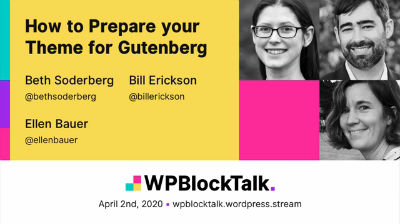
Bill Erickson,Ellen Bauer, Beth Soderberg: Case Studies – How to Prepare your Theme for Gutenberg
WPBlockTalk April 2020Speakers: Bill Erickson, Beth Soderberg, Ellen BauerApril 16, 2020 — “This session begins with three separate case studies – from Bill Erickson, Ellen Bauer, and Beth Soderberg – to help you prepare themes for Gutenberg and concludes in a tremendous panel discussion.
Bill uses his time at the very beginning to show how to improve content management for clients by applying careful, thoughtful work to your themes. In the second presentation, Ellen talks about important considerations when working on themes that you plan to distribute to others (that is, themes you plan to sell or provide to a large audience for free). Then Beth helps us to build smarter starter themes using better default block styles and support.
After the presentations, each speaker returns to participate in a panel discussion about the challenges and considerations they couldn’t cover in their separate presentations.”
-
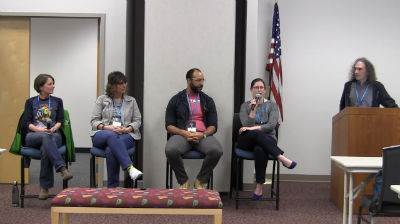
Working and thriving solo or as a small agency
WordCamp Lancaster 2019Speakers: Beth Soderberg, Joe Howard, Lee Drozak, Tara ClaeysJune 3, 2019 — This year’s keynote is a panel featuring Lee Drozak, Joe Howard, Beth Soderberg, and Tara Claeys. They’ll discuss building their businesses in a discussion moderated by organizer Charlie Reisinger.
-

Beth Soderberg: Help! I’m Behind on Gutenberg!
WordCamp Lancaster 2019Speaker: Beth SoderbergJune 2, 2019 — You missed the boat on Gutenberg. Either you believed its release would never actually happen, you thought there would be time to learn about it once it was out (and didn’t), or you didn’t really pay attention to what Gutenberg was and how it would impact you and your work until it was released this past December. Now you’re worried because you feel behind professionally and you’re not sure how to fill the gaps in your Gutenberg knowledge. Most importantly, you think: are you too behind to catch up? Do you need to find a different career? A different content management system?
The short answer is: no. Gutenberg is here to stay and, just like anything else, you can learn what you need to learn in order to continue your work with WordPress. We’ll talk about creating your own personal curriculum to “learn Gutenberg” by working through how to identify the gaps in our own knowledge and then how to identify resources to fill those gaps. In doing so, we’ll cover the basics of what Gutenberg is and how incorporating its existence into our workflows will impact different types of experts including content managers, project managers, designers, and developers.
As a case study, we’ll look at how I (a developer) “caught up” on Gutenberg after a 2018 where I didn’t have the time to focus on the ever-changing landscape of the Gutenberg project until right around its release.
-
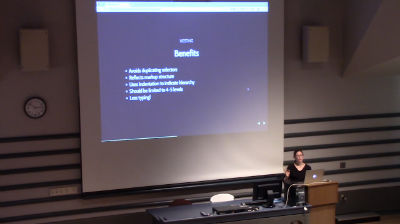
Beth Soderberg: SASS Is Not Scary
WordCamp Baltimore 2017Speaker: Beth SoderbergOctober 23, 2017 — Sass (Syntactically Awesome StyleSheets) has emerged as the dominant CSS extension and preprocessor used by front end developers. At first, I was afraid to make the jump from writing vanilla CSS to learning Sass, but once I dedicated myself to the concept of learning Sass I found that it wasn’t as hard to learn as I thought it would be AND that it also made my code more elegant and my development process more efficient. This talk will explore how to get started with Sass in a way that eases the transition to using a preprocessor. We’ll take a look at a number of considerations regarding Sass, including how to set up a WordPress theme to use it, the basics of variables, mixins, nesting, and partials, and helpful resources to learn more.
-

Beth Soderberg: Lessons Learned from Rebuilding My First Website
WordCamp Lancaster 2017Speaker: Beth SoderbergMarch 15, 2017 — I built my first large WordPress site five years ago and just completed rebuilding that very same website. In rebuilding this site I have had the unique opportunity to rethink many of the same problems that presented themselves before and also to reevaluate the work I did the first time around.
This talk will cover a range of beginner mistakes I made in the first build and the way approached solving these same problems now. We’ll also talk about how some changes I’ve made to the new site are a result of trends and technology changes over time.
Overall, this talk is for anyone who is getting started with building WordPress sites with complex data structures and requirements. My hope is that you’ll learn some of the lessons I learned the hard way the easy way!
-

Beth Soderberg: Color Theory and the Fundamentals of Design
WordCamp US 2016Speaker: Beth SoderbergDecember 23, 2016 — A series of flash talks.
-

Beth Soderberg: I Learned to Code Through WordPress and So Can You
WordCamp Baltimore 2016Speaker: Beth SoderbergNovember 21, 2016 — I was a writer and executive assistant with a solid liberal arts education when I first encountered WordPress in 2009. Since then, I’ve gone from knowing only very small bits of HTML to working full time as a developer. In this session I’ll talk about how I transitioned to a career in web development while working full time. We’ll also cover suggestions on what to learn first, strategies on how to learn technical subjects, resources I’ve found helpful both offline and around the web, how to get experience with real projects, and perhaps most importantly, how the WordPress community can be an amazing resource to help guide you along the way.
-

Beth Soderbergh: Introduction to Flexbox
WordCamp Pittsburgh 2016Speaker: Beth SoderbergSeptember 30, 2016 — The flexible box layout model, also known as flexbox, is an alternative method of creating layouts using CSS. It has gained popularity amongst front end developers over the last year or so as browser support for it has increased dramatically. This talk will introduce the flexbox model, examine when to consider using flexbox in your projects, and will address browser compatibility issues you may encounter in implementing flexbox.
-
Beth Soderberg: CSS Transforms, Transitions, and Animation Basics
WordCamp Northeast Ohio 2016Speaker: Beth SoderbergJune 17, 2016 — You’ve got the basics of CSS down, but you are ready to kick it up a notch and add a bit more pizazz and interactivity to your websites. In this session we’ll explore the fundamentals of CSS transforms, transitions, and animation. What are the basic building blocks that make up these capabilities? What is the difference between a transition and a transform? What does browser support look like? Most importantly, how can you put these tools to use in your next project and where can you find good resources to learn more? We’ll answer these questions and more as we explore the basics of how to add some of the more truly dynamic elements of CSS to our websites.

An  Ruckus
