
‘Security’ Videos
-

Alfonso Frachelle: No voy a hablar de seguridad
WordCamp Montevideo 2018Speaker: Alfonso FrachelleMay 29, 2020 — ¿Por qué y cómo debo asegurar mi WordPress? Alfonso Frachelle nos muestra las mejores práctica para que tu sitio web hecho en WordPress no tenga brechas de seguridad.
-

Fast alles zum Thema WordPress Sicherheit
WordPress Meetup PotsdamSpeaker: Bernhard KauMay 14, 2020 — Bernhard erklärt in seiner Session zum Thema “(Fast) Alles zum Thema Sicherheit” worauf es ankommt. Die drei wichtigsten Aspekte: Updates, Backups und ein starkes Passwort.
Weitere Sicherheitsaspekte die möglich sind, beschreibt Bernhard als optional oder gar unnötig. -

Nigel Pentland: Security testing – outside looking in
WordCamp Glasgow 2020Speaker: Nigel PentlandApril 22, 2020 — I’ll start by trying to convince folks why they should be considering the subject of security testing in relation to their WordPress sites. Assuming I’ve managed to convince you why, then I’ll move onto showing you just how anyone can use Kali (don’t worry, I’ll explain what Kali is!) as a tool for doing some basic security testing with a minimal learning curve to get started. This is being aimed at the novice level in terms of ‘security people’ but very inclusive in terms of anyone who is part of the WordPress community.
-

Georg Knabl: Ein Drittel des Internets hacken? WordPress-Sicherheit aus der Sicht eines Hackers
WordCamp Vienna 2020Speaker: Georg KnablApril 18, 2020 — Die große Verbreitung von WordPress macht es zu einem interessanten Ziel für Angreifer. Dieser Talk zeigt das beliebteste CMS aus Sicht eines Angreifers: Welche Sicherheitsmechanismen bringt WordPress mit? Wo sind generelle Schwachstellen? Wie laufen typische Angriffe ab? Darüber hinaus werden konkrete Angriffe exemplarisch erläutert.
Die vorgestellten Schwachstellen bieten Entwicklern und Betreibern einer WordPress-Installation die Basis für folgende Absicherungsmaßnahmen. -

Chathu Vishwajith: Hardening WordPress and Driving a Vehicle
WordCamp Utrecht 2018Speaker: Chathu VishwajithFebruary 25, 2020 — I would like to talk about recent serious security incidents had with WordPress installations and Start with the general points that anybody who is going to use or currently using WordPress needs to put their attention compared with driving a vehicle. Then I will suggest few plugins and services that I use and will request the audience to engage and let their suggestions too.I have mastered Art of hardening WordPress installation more than 30+ in Sri Lanka and other clients abroad.
-

Mikey Veenstra: 3 Security Mistakes You Didn’t Realize You Made
WordCamp Portland 2018Speaker: Mikey VeenstraDecember 31, 2019 — We all take shortcuts sometimes. Whether you were swamped with client work and a corner had to be cut, or you’re stretched so thinly trying to wear every hat that something fell through the cracks, we’ve all encountered mistakes we made ourselves. While they’re mostly all forgivable, it becomes a bit of a different issue when a mistake leads to a security concern. In this talk we’ll look at three common security mistakes made by WordPress site owners every day, why they get made in the first place, and how to resolve them.
-
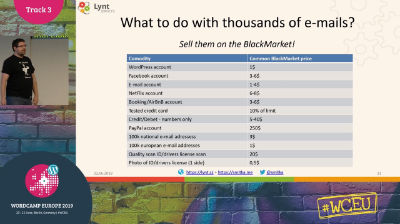
Vladimir Smitka: WordPress through the bad guys’ glassed
WordCamp Europe 2019Speaker: Vladimír SmitkaDecember 30, 2019 — Vladimír will give a 10-minute preview of common but not often-mentioned mistakes he saw during security scans of WordPress sites, specifically: Username and email leaking, full path disclosures, accessible backups, open .git repositories and DoS capable endpoints. He will also provide tips on how to reduce risks, where it is worth restricting access, how to enable Bcrypt password hashing and 2FA, and what configuration directives you need to check.
-
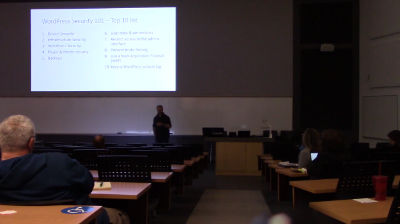
Todd Dow: WordPress Security 101
WordCamp Niagara 2019Speaker: Todd DowDecember 30, 2019 — Security is hard. And scary. And oh so confusing. But it doesn’t have to be that way. With WordPress, the basics are built in and you’re a simple checklist away from hardening your WordPress site like a pro. In this session, Todd will use plain english, entertaining stories and an all encompassing top 10 list to take you from newbie to knowledgeable in less than an hour.
-

Mikey Veenstra: What The Hack? Fortifying Your Security by Understanding Your Adversary
WordCamp Seattle 2018Speaker: Mikey VeenstraDecember 19, 2019 — Malicious activity is an unfortunate reality when maintaining a web presence today. Most people involved in the web industry know someone who encountered the aftermath of a disruptive attack–if they haven’t themselves. Because of this, awareness of security best practices is at an all-time high. To many, though, it may not be clear exactly why these measures are important.
To remedy that, we’ll be taking a practical look at what’s actually happening when a website gets attacked, as well as discussing the hows and whys along the way. From understanding why small sites still get hacked, to why password reuse is really as bad as everyone says, we’ll explore the rationale behind the security principles you’re always being told to follow.
-

Chris Teitzel: With Great Power Comes Great Responsibility
WordCamp Seattle 2018Speaker: Chris TeitzelDecember 19, 2019 — As developers, we are capable of many amazing feats. We can create experiences that touch the lives of millions, brings aid to the corners of the world, empowers new businesses and bring a voice to the voiceless. WordPress powers over 30% of the entire web! However with this capability, we must also take on the responsibility for the people, and data, we interact with.
During this session, we’ll discuss how a culture of security can benefit not only your organization but also protect your end users and yes even the world. We’ll look at the ethics of privacy, secure web design and architecture, and the impact our decisions have on the community and our users. Mixed in will be best practices for secure coding, how to manage sensitive data from clients and users, compliance with various regulations and laws around privacy, and how to foster a culture of security even while you manage distributed teams. I’ll share my experiences from almost a decade in Open Source and some of the mistakes and successes I’ve had along the way.
Most of all, as WordPress continues to empower more and more of our digital world, it is up to us to decide as a community how we will use this influence and together we can work to make the world a better and safer place for people no matter where they come from.

An  Experiment
