
Archive for August, 2018
-

Jake Aull: More than Yoast
WordCamp Atlanta 2018Speaker: Jake AullAugust 22, 2018 — More Than Yoast – SEO beyond the Yoast plugin & the future Schema/Rich Snippets, Mobile Optimization/AMP, GoogleSearchConsole & the future with WordPress Gutenberg
Installing and inputing Yoast fields is pretty easy. But there’s more to great search engine optimization than just that! Data structuring, Search Console data… What’s important, what’s not, and how will WordPress SEO change with Gutenberg? We’ll go into it all from strategy to execution tips.
-

Christine Laikind: Making the case for accessibility
WordCamp Atlanta 2018Speaker: Christine LaikindAugust 22, 2018 — Christine Laikind, born deaf, and founder of SCS Digital Marketing has made it her mission to share her knowledge and experience about (lack of) accessibility and website compliance to the WordCamp attendees.
-

Haroon Quyyum Raja: The what, why and how of WordPress performance
WordCamp Karachi 2018Speaker: Haroon Quyyum RajaAugust 22, 2018 — This talk is about what and how one can enhance WordPress performance and why one should boost up the speed of WordPress.
-

Piotr Niewiadomski: Automatyczny GIT deploy w WordPressie
WordCamp Poznań 2018Speaker: Piotr NiewiadomskiAugust 22, 2018 — Piotrek opowie o automatyzacji procesu deploymentu oraz aktualizacji strony z wykorzystaniem repozytorium GIT. Szczegółowo zostanie omówiona integracja WordPressa z popularnymi systemami kontroli wersji (Github, Bitbucket, Stash) dzięki WebHooks API. Przytoczonych zostanie kilka case study, do czego to się może przydać. Będzie technicznie, nie zabraknie slajdów z kodem źródłowym oraz osławionych już krówek i innych upominków od firmy Clearcode
-

Wolf Bishop: WordPress Security: 5 Things You MUST Do
WordCamp Atlanta 2018Speaker: Wolf BishopAugust 22, 2018 — WordPress security can be a difficult thing to get right. There are a number of things that go into a secure web site. In this quick talk, I will highlight the things I believe are the most important steps you can take to secure your site. You will learn in just 15 minutes how to ensure that your site is well protected from malicious actors.
-

Nadia Kerr: Basics of Search Engine Optimisation
WordCamp Sydney 2018Speaker: Nadia KerrAugust 21, 2018 — Basics of SEO – Search Engine Optimisation for WordPress
Understand search results (organic vs paid)
SEO versus SEM
Understanding search intent
Keyword research
Ways to improve search engine ranking
Using SEO plugin in WordPress -
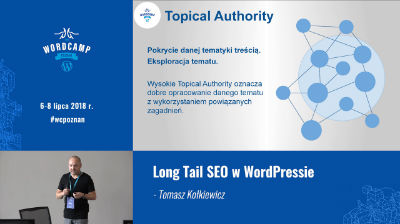
Tomasz Kołkiewicz: Long Tail SEO w WordPressie
WordCamp Poznań 2018Speaker: Tomasz KołkiewiczAugust 21, 2018 — Na czym polega długi ogon w SEO i od czego zależy jego wielkość. Jak budować i rozwijać strony, aby wykorzystywać potencjał długiego ogona. Z jakich narzędzi korzystać. Jakie możliwości pod kątem long tail oferuje nam WordPress.
-

Maciej Swoboda: WordPress Love
WordCamp Poznań 2018Speaker: Maciej SwobodaAugust 21, 2018 — Dzielenie się swoją wiedzą, umiejętnościami i wspieranie rozwoju jest tym, co napędza WordPressa i naszą rosnącą społeczność.
Podzielę się z Wami moją osobistą historią związaną z WordPressem. W WordPressie zakochałem się w 2006 roku i już wtedy wiedziałem, że zmieni on moje życie. Nie wiedziałem jednak jak bardzo. Na początku byłem tylko użytkownikiem, korzystałem z WordPressa, darmowych wtyczek i motywów, ale nie myślałem, żeby dać coś w zamian.
Wszystko zmieniło się w 2014 roku, gdy po raz pierwszy wziąłem udział w WordCampie i Contributor Day w Warszawie. Od tamtej pory aktywnie uczestniczę w życiu społeczności, organizuję lub występuję na spotkaniach wordpressowych. Prowadzę również firmę opartą w 100% na WordPressie, w której każdy z członków naszej drużyny poświęca co najmniej godzinę tygodniowo na wspieranie społeczności – to nasz projekt Godzina dla WP #godzinadlawp.
Kocham WordPressa, dlatego gdy ktoś mówi o kontrybuowaniu, nie myślę, czy to się będzie opłacało, albo co mogę z tego mieć dla siebie – myślę, kiedy mogę zacząć i jak mogę pomóc 🙂
-

Carl Alexander: Getting started with Continuous Integration and WordPress p3of3
WordCamp San Diego 2018Speaker: Carl AlexanderAugust 21, 2018 — Writing high-quality WordPress code is hard to do. It requires constant effort on our part and good self-awareness to know when we slipped up. But, if your business has any sort of success (which we all want!), you’re going to work with more and more people. And many of them are likely to touch with your code. This is going to put a strain on your development processes. It becomes harder to maintain a certain level of code quality. And you’re no longer the only person pushing code. You’re now part of a team and you need a way to standardize all of the things you once did on your own. That’s goal of continuous integration. It lets you automate your different development workflows from testing to deployment. This ensures that the quality of your code stays consistent. This talk will go over the basics of continuous integration. We’ll also go over some of the tools that are available. And then we’ll finish by looking at how you put these tools together to create your own continuous integration environment.
-

Carl Alexander: Getting started with Continuous Integration and WordPress p2of3
WordCamp San Diego 2018Speaker: Carl AlexanderAugust 21, 2018 — Writing high-quality WordPress code is hard to do. It requires constant effort on our part and good self-awareness to know when we slipped up. But, if your business has any sort of success (which we all want!), you’re going to work with more and more people. And many of them are likely to touch with your code. This is going to put a strain on your development processes. It becomes harder to maintain a certain level of code quality. And you’re no longer the only person pushing code. You’re now part of a team and you need a way to standardize all of the things you once did on your own. That’s goal of continuous integration. It lets you automate your different development workflows from testing to deployment. This ensures that the quality of your code stays consistent. This talk will go over the basics of continuous integration. We’ll also go over some of the tools that are available. And then we’ll finish by looking at how you put these tools together to create your own continuous integration environment.

An  Opus
Opus
