
Archive for 2019
-

Joost de Valk and Marieke van de Rakt: Thrive for the future – the business of open source
WordCamp US 2018Speakers: Joost de Valk, Marieke van de RaktJanuary 2, 2019 — For an open source community to thrive, it’s important that valid business models surround it. In this talk Marieke and I will discuss why a business model around open source projects is so important. The money that funds further development, but also funds conferences, marketing and education, has to be made somehow. We will cover the several large open source communities that exist today and discuss how successful the business models around them are.
But it’s not all about making money: it’s about giving back too. If every company in an open source community gives back, that community becomes unstoppable. The idea of five for the future is built on that. Other communities have similar ideas, and reward them in other ways, which we’ll discuss. We’ll also show why at Yoast, we think 5% is not enough.
-

Tracy Apps: UX design without diversity is not UX
WordCamp US 2018Speaker: Tracy AppsJanuary 2, 2019 — User Experience (UX) and Customer Experience (CX) design are in high demand these days and for good reason. Giant corporations are losing big money, big lawsuits, big customers, market share… or even *worse*. One key factor separating the successful businesses from those not, can be chalked up to an intentionally **diverse** and **inclusive** focus on UX/CX both online and off. Successful design is multifaceted, but a huge factor to UX/CX and Accessibility improvements in digital and public spaces are *directly* linked to an increase of diversity with those who create these spaces. If you think you have nothing to offer when it comes to improving the usability and accessibility of the products and sites you create and/or use, you’re absolutely wrong. In my over 20 years of experience designing solutions for users and customers, I have seen first-hand how important it is that I *unapologetically* bring my own individual diversity to the table. We have come a long way with design, yet still have a long journey ahead. But if we band together with our diverse rainbow of humans (pun intended), we will keep pushing technology forward, and everyone wins.
-

Jonathan Desrosiers: Building a Successful Code Review Culture
WordCamp US 2018Speaker: Jonathan DesrosiersJanuary 2, 2019 — A code review process has lots of benefits. In addition to the many technical and organizational benefits, there are also invaluable opportunities to set team members up to grow and succeed when an effective code review culture is adopted by everyone.
While working at Boston University’s Interactive Design department, Jonathan helped create a code review process that not only met the organization’s technical needs, but also established a culture that encouraged collaboration between designers, developers, and other departments throughout the University through code reviews.
This talk is a guided tour through that new process. We’ll discuss the technical aspects (such as the tools and integrations used), the organizational and workflow aspects, as well as the human factors, which are often ignored but are the most important to establishing a sustainable code review culture that will help your organization flourish.
-

Erika Hall: Design Research Done Right
WordCamp US 2018Speaker: Erika HallJanuary 2, 2019 — At this point, most product teams are making a good faith effort to be customer-centered and doing at least some research. Why does it seem like so many decisions are still based on speculation or personal opinion? Why is it still so hard to make a case for qualitative research?
All will be revealed. You’ll walk away better equipped to get the evidence you really need to create products and services people love.
-

Nicole Paschen Caylor: Elementary, My Dear Coder
WordCamp US 2018Speaker: Nicole Paschen CaylorJanuary 2, 2019 — Know a young child interested in learning computer science and coding, but the child’s reading level makes it difficult to know where to start? You’ve come to the right place! In this session we will go hands on with free online games that teach computer science and coding techniques to children as young as 4! These programs start with pre-reader courses and grow with your child so they can use the same program for years to come.
-

Prem Tiwari: Gutenberg the future of WordPress
WordPress Meetup BengaluruSpeaker: Prem TiwariJanuary 2, 2019 — Talked about “Gutenberg the future of WordPress” at WordPress bengluru Meetup.
-

Kyle Maurer: Ease of Use Inflation and WordPress
WordCamp US 2018Speaker: Kyle MaurerJanuary 2, 2019 — With each passing year, the bar gets higher for software developers. Customers seem to expect more and more from us with no tolerance for delays or price increases. What causes this vicious cycle? More importantly, what can we do to continue to provide tools which satisfy new users and meet their ever changing expectations regarding usability?
-
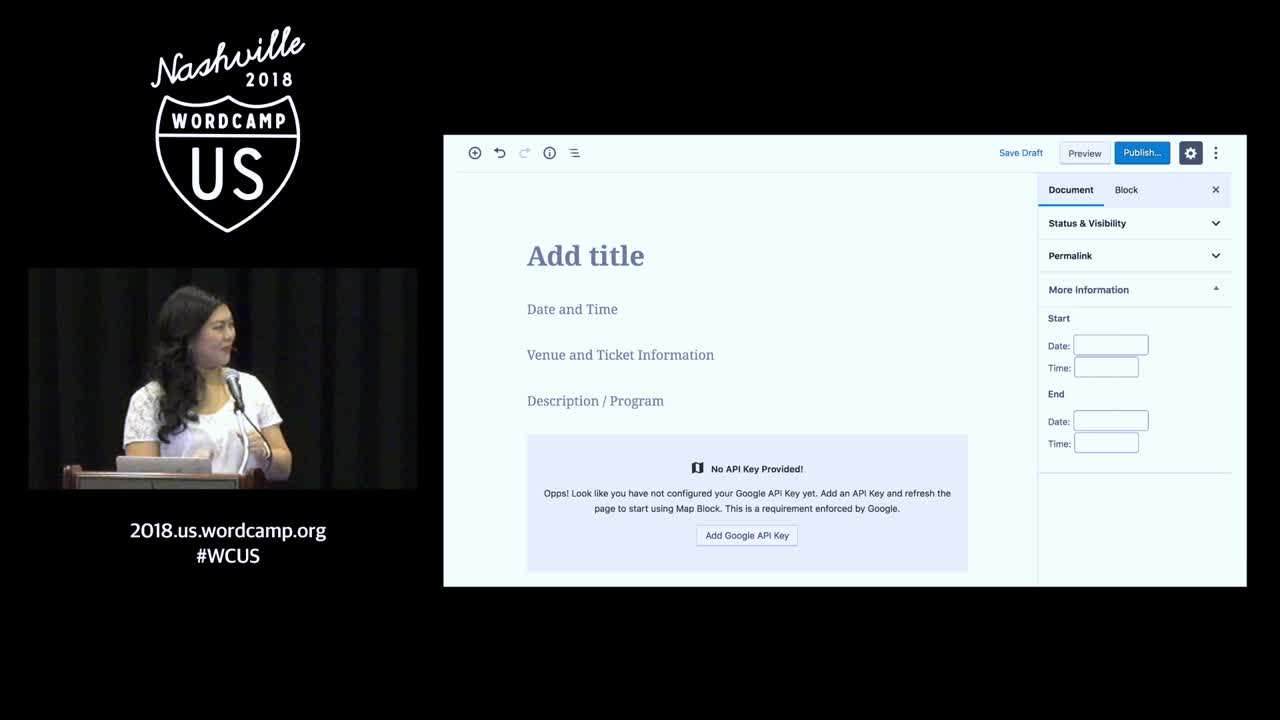
Helen Hou-Sandí: Metaboxes Considered Harmful
WordCamp US 2018Speaker: Helen Hou-SandíJanuary 1, 2019 — When it comes to plugins and themes in WordPress, we’ve heard some mantras over and over: “Your custom user interfaces should feel like a native part of WordPress! Follow the admin UI! Back-compat 4 life!” So what happens when a project like Gutenberg comes along and threatens everything you thought you knew about creating and editing content in WordPress?
One of the things about extending software is that you tend to stick to familiar paradigms and patterns, often at the cost of innovation and creating the best possible experience for a given task. One of the major tensions we’ve seen in the push forward on Gutenberg is between the tradition of backwards compatibility and the forward-looking concept of a block-based editor. The hesitation is natural and understandable, but it’s important to take a step back and ask “are metaboxes really the best UI for what my user needs to do?”
In this talk, we will take a look at some creative solutions from the past that have broken outside of the bounds of metaboxes and other form-centric interfaces while still maintaining that WordPress feel, along with practical examples of where rethinking the editing experience can and has led to significantly better outcomes for both implementers and users alike.
-

Molly Wright Steenson: Beyond the Trolley Problem
WordCamp US 2018Speaker: Molly Wright SteensonJanuary 1, 2019 — When we think about ethics and AI, our first thoughts often go to the question of what happens if a self-driving car kills a pedestrian. The life and death questions of autonomous systems are important to address—and so are other enormous questions like unfair bias, privacy, safety, and accountability. These aren’t just technical or policy questions: they’re design questions. Designers frame problems, shape the features and behavior of AI-enabled systems, and provide the levers that AI is allowed to pull. Designers are in a unique position to help with these problems about AI, design, and ethics, and in this talk, we’ll look at how.
-

Alexis Lloyd: The evolution and future of publishing
WordCamp US 2018Speaker: Alexis LloydJanuary 1, 2019 — The experience of creating and sharing information has changed dramatically over the last decade and will only continue to evolve. How do we understand the present moment and anticipate the future of publishing in order to keep pace with both user needs and emerging technologies?
This talk will provide a structured framework to help us understand how publishing has evolved (how we got to now) and what it might become in the near future. I will examine how the act of authoring has become more expansive, encompassing new kinds of users and different contexts for publishing, as well as how user expectations around content creation have changed. Which trends should we expect to see continue and where might we see radical changes in the publishing landscape? How might growing concerns around privacy affect how we create and publish online? In addition, we will explore emerging technologies like voice interfaces and machine learning, and examine what impact they might have on the future of publishing. Finally, we will look at the ways in which WordPress is uniquely suited to take advantage of the current moment, and what new opportunities could be in store for the future.

An  Ruckus
