
Author Archive
-

Marieke van de Rakt: Why site structure is important for SEO
WordCamp Nijmegen 2018Speaker: Marieke van de RaktJanuary 11, 2019 — In this talk I will cover the question why site structure is important for SEO. Next to that, I would like to give you some practical tips – three in total – on how to improve your site structure. So, how do you set up a good site structure? What should you do to structure your website in order to rank high in the search engines nowadays?
-

Steven Ayers: My website has been hacked! Security Planning
WordCamp Asheville 2018Speaker: Steven AyersJanuary 11, 2019 — Learn how to handle a hacked website in a moment of crisis.
A building has an evacuation plan. A website needs a security and disaster recovery plan.
Takeaways:
Who should I call if I’m hacked?
What should I do if I’m hacked?
How do I ensure this doesn’t happen again?
What needs to be in your plan
Risks and damages hacking has on your organization
Incident Response Plan -

Russell Fair: Developing and deploying high quality code, using TDD + CI/CD
WordCamp Asheville 2018Speaker: Russell FairJanuary 11, 2019 — In this presentation I’ll take a deep dive into my preferred development and deployment workflow. I’ll cover how to work with code quality tools such as PHPMD, PHP_CodeSniffer and JSLint, as well as how to implement Test Driven Development into a custom plugin. I’ll wrap the whole thing up by demonstrating how to connect everything to a continuous integration / delivery pipelines to test the code and deploy automatically.
Takeaways:
Code Quality
TDD
CI/CD -
Selling to Enterprise Clients
WordCamp Boston 2018Speaker: Jodie FiorenzaJanuary 11, 2019 — Enterprise clients are a unique group that requires special attention with their complex WordPress setups. In this talk, we will look at the methods to attract this level of client, how to convince them of the benefits of WordPress, and finally discuss the special considerations needed when working with Enterprise level clients.
-

Chris Lema: Scoping WooCommerce Projects
WordCamp Boston 2018Speaker: Chris LemaJanuary 11, 2019 — Not all WooCommerce projects are the same, but your goal is the same every time – to make sure you don’t lose your shirt on an eCommerce project because you did your estimating and scoping poorly. We’ll look at different kinds of WooCommerce projects and ways to help you scope the effort.
-
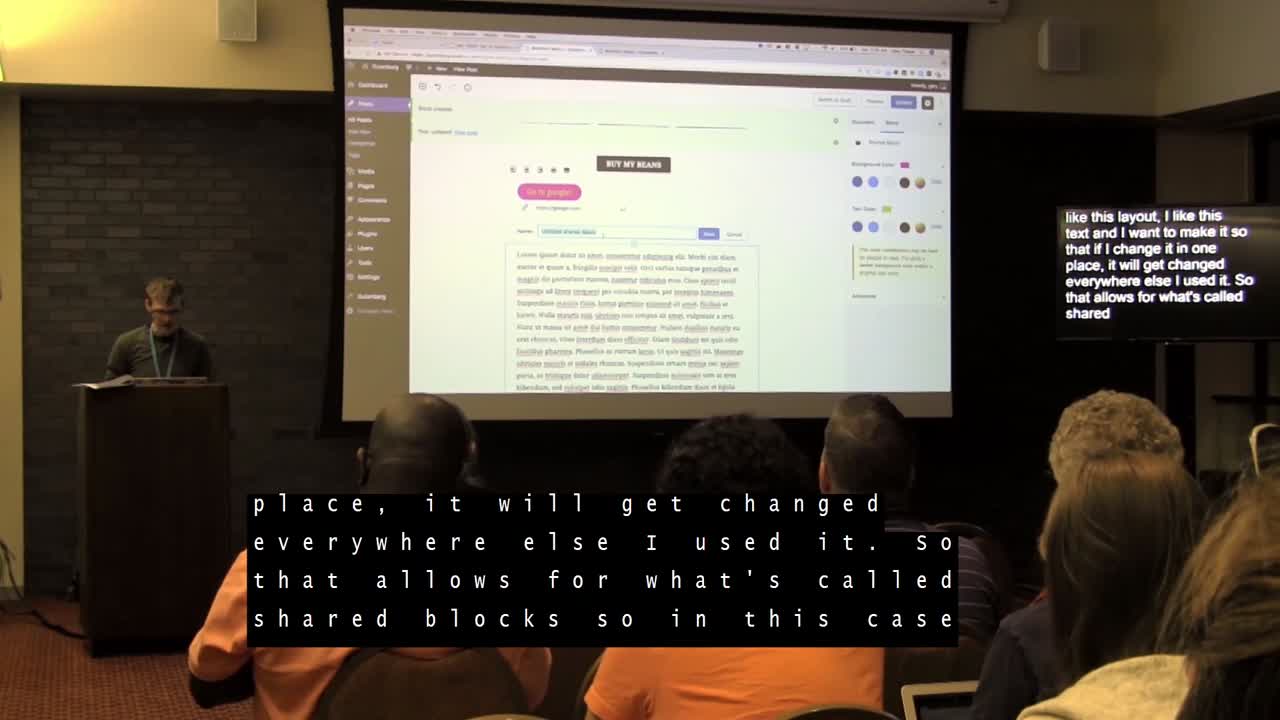
Gary Thayer: Say “Guten Tag” to Gutenberg
WordCamp Boston 2018Speaker: Gary ThayerJanuary 11, 2019 — Let’s take a look at the upcoming page editor Gutenberg, scheduled for release in WP 5.0.
We’ll look at:
What are Gutenberg blocks?
What blocks are available, and how to use them
How to best prepare your web site for the update -
Frank Corso: Speeding up WordPress
WordCamp Boston 2018Speaker: Frank CorsoJanuary 11, 2019 — Having your site load quickly is important for many reasons. Having a faster site impacts your SEO, sales, and user engagement. In fact, a 1-second delay in page response can result in a 7% reduction in conversions!
In this talk, we will be discussing the reasons why your WordPress site may be slow and showing you ways to make your site faster. You will learn about different tools to test your site speed as well as how you can make the changes these tools suggest.
-

Benjamin Kucmierz: Have You Tried Plugin’ it in – Client Support in WP
WordCamp Asheville 2018Speaker: Benjamin KucmierzJanuary 10, 2019 — The purpose of this talk is to discuss potential events, situations, and problems that can arise when clients come into contact with WordPress and the best practices to overcome those issues. Additionally, it would cover how to ‘user-proof’ your site to help minimize client-caused damage. Learn how to properly address and handle client complaints and problems.
Takeaways:
Learn how to explore and identify various site issues.
Learn how to minimize potential issues caused by clients. -
Jim Echter: Oh crap! We need a web site. Now what?
WordCamp Boston 2018Speaker: Jim EchteJanuary 10, 2019 — Go on the journey of a “mere mortal” (someone without a computer background) on how they learned WordPress, designed two business sites and opened an on-line store with Woo Commerce. Your trip guide will take you through the WP basics, identify tripping and stumbling points, direct you to where to get information, introduce you to the language of WordPress, where to “hotel” your site, and overview safety tips for your journey.
-
Kevin Hoffman: Optimizing Responsive Images in WordPress
WordCamp Boston 2018Speaker: Kevin HoffmanJanuary 10, 2019 — While the benefits of image optimization are well known, in practice, it is one of the most misunderstood topics in all of WordPress. With the addition of responsive images and an influx of new solutions in the marketplace, the topic of image optimization deserves an updated take on best practices for the modern responsive landscape.
This talk begins with a step-by-step analysis of how WordPress processes images by default. With this baseline understanding established, we will review common misconceptions about image optimization techniques that sometimes do more harm than good. One such example is the practice of optimizing images *before* upload, which actually has no effect on the generated image sizes.
By exploring a combination of best practices and common snafus, the audience will take away the key concepts necessary to optimize responsive images in a manner that works with WordPress, not against it.

An  Medley
