
‘Gutenberg’ Videos
-
Alain Schlesser: Building a Realtime Status Page using the Combined Power of Gutenberg and Firebase
WordCamp Brighton 2019Speaker: Alain SchlesserOctober 29, 2019 — Modern infrastructure technologies like serverless computing and real-time databases offer a huge potential for new and improved online user experiences.
In this session, we’ll go through a practical use case to find out how we can harness their power in the context of WordPress.
We’ll build a Gutenberg block that shows status updates, to be incorporated into a status page. We’ll use serverless computing to allow adding status updates via a Slack command, and we’ll use a real-time database so that all visitors receive these updates in real-time without any impact on our WordPress server.
-
Rua Haszard Morris: Cool stuff inside Gutenberg: build the perfect UI with @wordpress/components
WordCamp Brisbane 2019Speaker: Rua Haszard MorrisOctober 21, 2019 — A brief dive into the component library built into WordPress / Gutenberg. I’ll use a little demo plugin to demonstrate how useful these components are, and how you can use them to build the perfect authoring interface for your custom content, and more.
https://2019.brisbane.wordcamp.org/session/custom-interactivity-with-gutenberg-components/
-

José Ángel Vidania: Bloques reutilizables, plantillas de bloques y otras hierbas
WordCamp Valencia 2019Speaker: Jose Ángel VidaniaOctober 21, 2019 — Con la llegada de los bloques al nuevo editor de WordPress existen nuevas opciones para interaccionar con nuestro contenido como los bloques reutilizables, los estilos de bloque o las plantillas de bloques. En esta charla explicaré cómo podemos hacer uso de todas estas funcionalidades con el nuevo editor de WordPress.
-
Riad Benguella: Gutenberg, au delà de l’éditeur de contenu
WordCamp Paris 2019Speaker: Riad BenguellaOctober 21, 2019 — Après quinze années d’existence et une telle popularité, il est très facile d’opter pour la sécurité au détriment de l’innovation au risque de sombrer dans la médiocrité. Alors comment se réinventer tout en gardant son identité ? Comment innover sans aliéner ses utilisateur·rice·s ?
Gutenberg est la réponse de WordPress. C’est un changement d’une ampleur jamais vue dans l’histoire du CMS. Au delà du changement visible au niveau de l’éditeur de contenu, Gutenberg ouvre la voie à un changement encore plus profond pour WordPress qui pourrait redéfinir votre expérience de WordPress quel que soit votre profil.
Après avoir réinventé son éditeur, comment les prochaines phases de Gutenberg vont-elles redéfinir l’utilisation de WordPress pour les développeur·se·s d’extensions, développeur·se·s de thèmes, les agences Web et les utilisateur·rice·s finaux·ales ? Quelles sont les étapes pour y arriver alors ? Comment participer activement à ce changement au lieu de le subir ?
Cette conférence répondra à toutes ces interrogations.
-

Tammie Lister: A tale of Gutenberg usability testing
WordCamp Milano 2017Speaker: Tammie ListerOctober 11, 2019 — This is a tale of how usability testing began as a community project and grew. Discover along the way the results and how they influenced the project so far. Learn how to run usability tests and also a lot more about Gutenberg along the way.
-
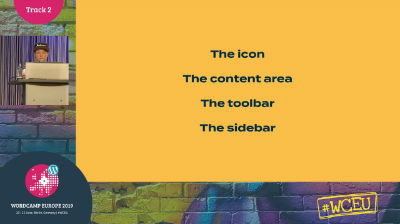
Mel Choyce: Designing your first Gutenberg block
WordCamp Europe 2019Speaker: Mel ChoyceSeptember 19, 2019 — Sometimes the hardest part of a new project is just getting started. In this new Gutenberg-powered world, what does it mean to design a block? Where do I put my shortcode attributes? What’s this toolbar? Mel will show you examples of blocks she designed and go over the basic anatomy of a Gutenberg block. You’ll learn how a block is structured, where to put your settings, and user experience tips to ensure your users or customers are set up for success. No prior design experience is required, and developers are encouraged to attend!
-

Puneet Sahalot: New Business Opportunities with Gutenberg
WordCamp Nagpur 2019Speaker: Puneet SahalotSeptember 19, 2019 — Gutenberg is the new WordPress Editor. It has great capabilities for building the custom page and post layouts. Many users have started using Gutenberg to build Complete website. With Gutenberg arrival, there is a wave of new plugins, how-to videos and blog posts. In this session, Puneet shares insights on new opportunities generated by Gutenberg.
-

Mauricio Gelves : Gutenberg Blocks Development for Programmers with NO Time
WordCamp Athens 2019Speaker: Mauricio GelvesSeptember 12, 2019 — “His prayers were heard. He knew that sooner or later the WordPress Community would create a software to ease the creation of Gutenberg Blocks. Elliot Condon and his team, from the well known ACF plugin, were responsible for this miracle that has saved Mauricio lots and lots of hours of work in his projects.
He invites you to come and see how easy is to implement them and be proud to call yourself a Gutenberg Block Developer. “
-
Felix Arntz: Leveraging the Power of Custom Elements in Gutenberg
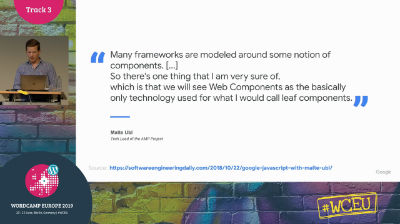
WordCamp Europe 2019Speaker: Felix ArntzSeptember 12, 2019 — If you have worked with JavaScript over the years, chances are you used a mechanism to define reusable components that are rendered and can be interacted with in an encapsulated manner, for example in React or Vue. Web Components is a set of features that introduces similar mechanisms natively to the browser. Having a standard layer for these so-called leaf components aids interoperability. Imagine a future where you can reuse a leaf component you wrote for a simple native JS application in a React application or vice versa. Felix will teach you how to leverage Web Components by example, such as usage by the AMP framework or within Gutenberg blocks.
-

Panel: Growing beyond Gutenberg. From block-based editing to site administration
WordCamp Europe 2019Speakers: Felix Arntz, Kåre Steffensen, Mark Uraine, Elio Rivero, Tom J NowellSeptember 5, 2019 — WordPress success is the success of our community, and currently, WordPress is going beyond its own barriers and limits. The Gutenberg project is transforming WordPress into an even more powerful editing tool that will change our idea of modern day web editors.
Whether you are familiar Gutenberg or not, this discussion panel moderated by Hannah Smith will let you know the different phases of the project and you’ll find out first hand from the experts the latest Gutenberg news and updates. Join us to find out more!
Hosted by Hannah Smith
Panellists:
– Elio Rivero
– Mark Uraine
– Kåre Steffensen
– Felix Arntz
– Tom Nowell

An  Medley
