
‘Gutenberg’ Videos
-

Beth Soderberg: Help! I’m Behind on Gutenberg!
WordCamp Lancaster 2019Speaker: Beth SoderbergJune 2, 2019 — You missed the boat on Gutenberg. Either you believed its release would never actually happen, you thought there would be time to learn about it once it was out (and didn’t), or you didn’t really pay attention to what Gutenberg was and how it would impact you and your work until it was released this past December. Now you’re worried because you feel behind professionally and you’re not sure how to fill the gaps in your Gutenberg knowledge. Most importantly, you think: are you too behind to catch up? Do you need to find a different career? A different content management system?
The short answer is: no. Gutenberg is here to stay and, just like anything else, you can learn what you need to learn in order to continue your work with WordPress. We’ll talk about creating your own personal curriculum to “learn Gutenberg” by working through how to identify the gaps in our own knowledge and then how to identify resources to fill those gaps. In doing so, we’ll cover the basics of what Gutenberg is and how incorporating its existence into our workflows will impact different types of experts including content managers, project managers, designers, and developers.
As a case study, we’ll look at how I (a developer) “caught up” on Gutenberg after a 2018 where I didn’t have the time to focus on the ever-changing landscape of the Gutenberg project until right around its release.
-

Benjamin Ritner: WordPress Themes in the Age of Gutenberg
WordPress Santa Clarita Valley MeetupSpeaker: Benjamin RitnerMay 17, 2019 — The WordPress Santa Clarita Valley Meetup is proud to welcome Benjamin Ritner of Kadence Themes from Missoula, Montana to our meetup to talk about his WordPress themes and the future with Gutenberg.
-

Mika Epstein: The Magical Repeatable Gutenberg Block
WordCamp Manchester 2018Speaker: Mika EpsteinMay 15, 2019 — Gutenberg. It’s real, it’s happening, and it’s terrifying because you don’t know how you’re going to do everything you do today. What if I told you that for the majority of the simple tasks out there, no only will you still be able to do them, they’ll be even easier? Let me show you how with the magical, repeatable, Gutenberg block.
-

William Earnhardt: Gutenberg Phase 2 and the Future of WordPress
WordCamp Raleigh 2019Speaker: William EarnhardtMay 10, 2019 — The first phase of the Gutenberg project is complete and the new block-based editor was released in WordPress 5.0. So what happens next?
I’ll go over where we are now, some of the concepts and ideas that have been proposed and are actively being worked on for Gutenberg phase 2, and ruminate on what these big and exciting changes might mean for the future of WordPress.
-

Rohit Motwani: Adapt or dine – How to make your plugin Gutenberg compatible and WooComerce QandA
WordPress Meetup BarcelonaSpeaker: Rohit MotwaniMay 8, 2019 — On the 19th of march, part of the WooCommerce team came to Barcelona to debate about WooCommerce but first we had the special meetup about and Gutenberg by Rohit Motwani.
Gutenberg is the project name of the brand new editor for the WordPress platform that was released as part of WordPress 5.0. It has the potential to radically change the way we create posts, pages, products, and basically everything else on your site. It opens the door to unifying the different parts of the website building process, making it easier for website creators.
For plugin authors, this change can be a challenge. Do I have to update my plugin? How do I know? If so, how do I adapt? The WooCommerce Support team is coming to Barcelona to answer all of these questions. We are looking forward to meeting you!
– Speaker: Rohit Motwani
Rohit Motwani is a Happiness Engineer at Automattic, specializing in supporting WooCommerce customers via tickets, livechat and in forums. He has been involved with testing Gutenberg with WooCommerce in mind and is a strong advocate for adaption and adoption in India and beyond. Find out more here: https://rohitmotwani.com/– WooCommerce Team attending:
Aashik Poonja, Grigorij Urasov, Hari Shanker, Ines Van Essen, Luminus Alabi, Stuart Duff, Valentina Thörner -
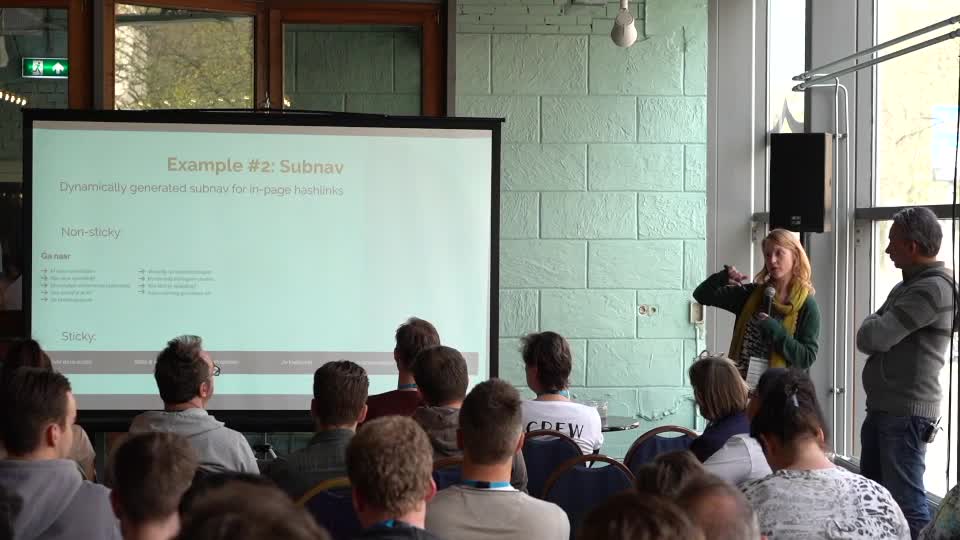
Veerle Verbert and Werner Huysmans: Maak een Gutenberg-compatibel thema (basics and the quest)
WordCamp Rotterdam 2019Speakers: Veerle Verbert, Werner HuysmansApril 24, 2019 — WordPress 5.0 is voor thema-bouwers een game changer. Wij gingen begin 2019 een eerste keer de uitdaging aan: een maatwerk WordPress website met Gutenberg als editor en op basis van aangeleverd design.
In deze talk delen we onze ervaring: we geven quick wins voor hoe je een thema Gutenberg-ready kan maken en delen welke consequenties en mogelijkheden Gutenberg heeft voor maatwerk sites. (spoilers: Learn JS and/or CSS Deeply & re-educate your designers)
-

Pascal Birchler: WordPress Internationalization Workflows
WordCamp Johannesburg 2018Speaker: Pascal BirchlerApril 14, 2019 — Soon after the release of WordPress 15 years ago, support for internationalization was added to the software. This meant that themes, plugins, and WordPress itself could be translated. This was a huge deal as WordPress is used all over the world, in countries where English is not the main language. WordPress was quickly translated into German, Japanese and many more languages.
Over the years, WordPress has steadily improved the way we have to work with internationalization. However, challenges still exist and there will always be new ones ahead. Projects like Gutenberg and ecosystems beyond WordPress.org force us to continuously iterate.
In this talk you’ll learn how to make use of the latest and greatest technology to make your WordPress plugin or theme fully internationalized. Pascal is going to highlight how you can leverage the powers of WordPress, GlotPress, and WP-CLI to improve the translation workflow in your WordPress projects.
-

Daine Mawer: Gutenberg – What you need to know for the next generation of WordPress
WordCamp Johannesburg 2018Speaker: Daine MawerApril 14, 2019 — As we move closer to the next major release of WordPress, the more anticipation grows around the impact Gutenberg will have on past, current and future WordPress sites. Not only will this revolutionary change effect the overall experience of WordPress as a platform, but it will also open a wave of questions, challenges and hurdles for WordPress developers, business owners and end users. In this talk, I will give you the low down of everything you need to know to prepare for the release of Gutenberg in WordPress core. Everything from how Gutenberg will change your business model, what WordPress developers need to know in terms of technical skills to keep up to date, and how it will dramatically change how we think and deliver content through WordPress
-

Mark Wilkinson: Transitioning to a block-based editor in a pre-Gutenberg world
WordCamp Edinburgh 2018Speaker: Mark WilkinsonApril 11, 2019 — How do we move towards a block-based admin UI in a pre-Gutenberg WordPress?
With the rise of page builders and ‘block-based’ layouts, and the imminent arrival of Gutenberg – WordPress’ new block-based editor – we needed a solution for transitioning towards this new way of editing content while sticking with the mature and stable technology stack that we know and love.
We, therefore, set out to find another solution and this led to the development of the HD ACF Blocks plugin that we use on most sites today.
This talk introduces the plugin, how we built it, how it works, and how it provides value to our clients and our business.
-

Vaishnavi Patel: Gutenberg, The New Generation WordPress Editor
WordCamp Kolkata 2019Speaker: Vaisnavi PatelApril 9, 2019 — Vaishnavi Patel is sharing his understanding about using Gutenberg editor.

An  Thingamajig
