
Author Archive
-

David Hilditch: Scaling WooCommerce to 1 Million Products on a Basic Server
WordCamp Brighton 2016Speaker: David HilditchAugust 14, 2016 — I have been working a lot on building WooCommerce stores that scale. I built a server stack and plugins, which combined, deliver phenomenal performance and scalability – catapulting WooCommerce into the leagues of enterprise eCommerce stores.
I have helped Datafeedr and WP All Import optimise their plugins, and my WooCommerce plugin makes the /shop/ page load in 0.2 seconds compared to the standard 63 seconds for a 45,000 product store.
I’ll talk about:
How this level of performance is going to change the market place, making it possible and easy for store owners to massively expand their inventory – particularly through drop-shipping and affiliated products.
Best practices for selling stock alongside drop-shipped and affiliated products to maximise your store’s revenue and provide a better service for your customers that grows more quickly as a result.
How I have achieved such levels of code performance, the common performance bottlenecks that exist and how developers can make sure their plugins don’t cause the same mistakes. -

Sarah Semark: The Unbearable Likeness of Design
WordCamp Brighton 2016Speaker: Sarah SemarkAugust 14, 2016 — Why do so many websites look the same? As our tools have improved and we’ve been able to do more with the web, there’s been a growing trend toward websites that look exactly alike. Why did this come to be, and what can we, as designers and curators of the modern web, do to avoid it?
In order to answer these questions, we’ll touch briefly on the history of web design, and examine how modern tools and practises have contributed to a more homogeneous-looking internet. We’ll examine the web design process from two perspectives – the designer’s and the developer’s – and discuss how the blurring of those roles impacts the design process. Along the way, we’ll discuss the various merits of following or bucking trends. Finally, I’ll offer some constructive advice to help you – whether you’re a designer or not – add an individual touch to your design work.
-

Misumi Takuma: これからWordPressを頑張りたい人へ。子テーマを作って公式テーマディレクトリに登録しよう!
WordCamp Kansai 2016Speaker: Misumi TakumaAugust 14, 2016 — 去年の12月Twentysisteenの子テーマ「Wilow」を公式テーマディレクトリに登録しました。
当時WordPress歴1年経たないぐらいでしたが、公式テーマを作ることでいろいろ勉強になりました。
本セッションでは、子テーマを作った方がいい理由や、公式テーマディレクトリに登録するメリット、公式テーマディレクトリに登録するのは思ったより難しくないよということをお話しします。
今年のWordCampKansaiのテーマ「for the future」にちなんで、
これからWordPressを学びたい人たちに聞いて欲しいと思っています。 -

Nathan Ingram: Dealing With Problem Clients
WordCamp Asheville 2016Speaker: Nathan IngramAugust 14, 2016 — Spend time talking with a group of freelancers and the conversation will inevitably include someone’s unfortunate experience with a terrible client. Most freelancers have a story or two (or eight). While bad clients can’t be completely avoided, there are strategic steps any freelancer can take to contain the impact of a bad client. In this session, Nathan will explain the how to create a system that preserves workflow and keeps problem clients in check.
Take aways:
Four strategies that will keep problem clients in check.
Five monsters you should know and how to contain them.
The payoff of building good fences. -

Peter Baylies: Picking Your Server Platform
WordCamp Asheville 2016Speaker: Peter BayliesAugust 14, 2016 — WordPress runs on a technology stack that provides many options for your choice of web server, database, version and flavor of PHP; this talk explores the commonly used options, and the various pros and cons of each choice, i.e., nginx or apache; PHP 5.x, PHP 7, or HHVM; and MySQL or MariaDB.
Take aways:
No tool is best for all jobs.
There are many implicit trade-offs to consider with software platforms, such as optimizing for speed vs memory usage, or using an older solution because it may be more stable, more well-tested, or more widely supported.
With any new project, these factors should be considered to ensure that you choose the best tools for your particular job. -

Patty Alman: WordPress as a Backend for Native iOS and Android Apps
WordCamp Asheville 2016Speaker: Patty AlmanAugust 14, 2016 — *This is a 15-minute Lightning Talk*
The WordPress API, recently added to WordPress core, offers exciting new possibilities for connecting WordPress data and functionality with external systems.
In this talk, you will learn about how one Asheville company has used WordPress as a backend for iOS and Android apps.
I’ll do a brief demo of the “War In Our Words iPhone” app, which provides a platform for veterans to share their own personal stories with the world. The app makes extensive use of the WordPress API for backend functionality including user registration, authentication, and data storage/retrieval.
This talk is for all audiences. While it will touch on a few technical issues, the talk is designed to introduce any level of user to the power and possibilities offered by the new WordPress API.
-

Russell Fair: Stop Doing That: 10 Lazy Mistakes That Break Things
WordCamp Asheville 2016Speaker: Russell FairAugust 14, 2016 — *This is a 15-minute Lightning Talk*
-

Josh Eaton and Adrienne Debigare: Getting Classroom Blogging Up and Running in Higher-Education
WordCamp Boston 2016Speakers: Adrienne Debigare, Josh EatonAugust 14, 2016 — The HBS Digital Initiative, in partnership with Reaktiv Studios, has been building a networked classroom blogging tool, called Open Knowledge. Our goal is to make Open Knowledge the destination to create, share, discover and engage in discussions about the future of business within the classroom and beyond.
Implementing such a platform within higher education requires specific technical and social considerations. What about FERPA? Do students feel comfortable doing work publicly and digitally? What back-end tools are need for grading and curation? How can conversations remain civil while also remaining public?
We will share our findings from the last year of design research, user testing, and iterative development. We’ll discuss the ways WordPress might be customized for use in a classroom setting, and then spend as much time as possible for Q&A. Our findings are incredibly compelling for broader implementation, and we are excited to help other schools figure out a similar roadmap!
-
K.Adam White: Machine Learning with WordPress
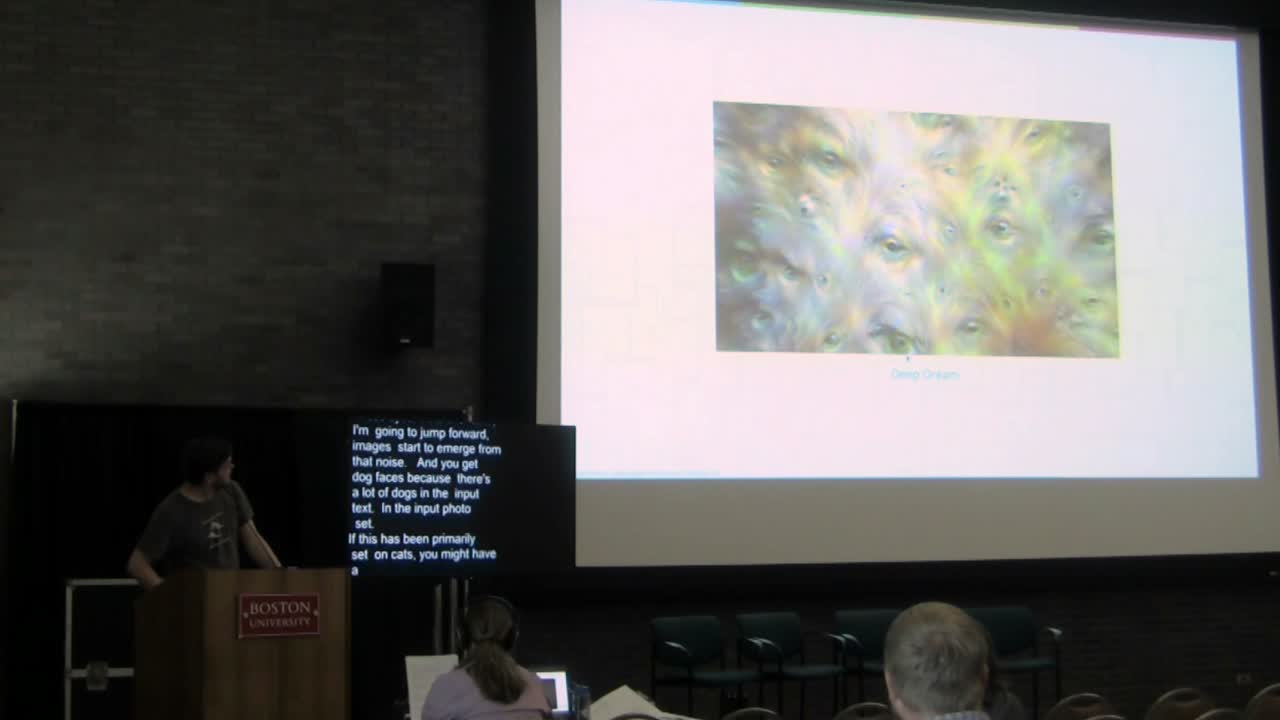
WordCamp Boston 2016Speaker: K. Adam WhiteAugust 14, 2016 — Machine learning, and in particular “deep learning”, have been in the news a lot lately: machine learning lets Google make psychedelic images; machine learning is helping computers to read handwritten text; machine learning lets Facebook match web users to advertisements; machine learning is being used to discover new construction materials. But what is it, and why does it matter to writers? In this talk we’ll learn the basics of neural networks, and see how poets and other writers can use machine learning techniques for creative results.
-
Daniel Miller: The Power of Templates
WordCamp Boston 2016Speaker: Daniel MillerAugust 14, 2016 — WordPress coders have gotten a bad rap for writing messy code. Its a little unfair as there are many great programmers in the community. However, some of the criticism is well deserved. There are far too many plugins and themes that are one big mess of spaghetti php.
WordPress is great, but it doesn’t give us the best tools to write quality code. However, with the use of a templating library such as twig, blade and many others, we have a tool that will help us write a higher quality piece of software. Templates not only have much cleaner syntax then using straight php tags, but they also enforce a separation of concerns.
This talk will cover the various templating options that are available as well the basic methodology and functions of templates.

An  Medley
