
Author Archive
-
Christie Witt: Migrating 1,300 websites from HTML to WordPress, a business process case study
WordCamp Toronto 2018Speaker: Christie WittDecember 28, 2018 — We migrated 1,300 websites from HTML to WordPress. Learn how I assessed the business processes beforehand, conducted a company-wide process audit and implemented improvements involving the client services, business account managers, sales, finance, marketing and IT teams. I will also discuss how I built the CRM requirements and worked directly with the CRM developers to track and automate reporting of the various website statuses such as cancellations, suspensions, and brand new website build requests. Finally, learn how I would have evaluated the impact of Gutenberg on the migration had it been released prior to the project.
• How to assess the big picture around website processes • How to work with different teams within a large corporation to educate them on business process updates • How to work with the older generation on selecting website templates for migrations • How a multi-site instance was set up for the migration of 1,300 websites -

Troy Fawkes: The One Stop Marketing Shop: Gutenberg’s Marketing Toolbox
WordCamp Toronto 2018Speaker: Troy FawkesDecember 28, 2018 — Can WordPress be the one stop shop for your marketing needs? Is it going to be there for you as you grow from a small business to a large one or will it let you down along the way? This session covers four critical digital marketing categories and how WordPress & Gutenberg support them through various stages of complexity.
Business owners, marketers, developers and designers will take away:The growth stages of the four critical digital marketing categories: SEO, paid ads, email and marketing automation, conversion rate optimization and UX.
WordPress’s support of your business through your growth stages, with a case study.
Powerful ways to leverage Gutenberg’s modular thinking for marketing. -
Rebeca Godin: WordPress as a Digital Marketing Hub: Gutenberg Edition
WordCamp Toronto 2018Speaker: Rebeca GodinDecember 28, 2018 — How to use your WordPress site and Gutenberg with various digital marketing plugins to grow your business.
We will discuss how your WordPress site is more than a just website. It can be a great platform to turn your website into a digital marketing powerhouse. We will cover plugins for reputation management, email marketing, social media feeds and sharing, retargeting, SEO and analytics. You will learn how to use plugins we recommend to get the desired exposure to get business growth. -
Andrea Zoellner: Copywriting for Better UX
WordCamp Toronto 2018Speaker: Andrea ZoellnerDecember 28, 2018 — When we think about UX, we’re often so focused on fonts, colors, and flow to think about those small bits of text that guide users through almost every part of a web interface—the microcopy. Gutenberg makes it easier to craft engaging multimedia content and improve the user experience of your site. But what about the less sexy parts of a website like menu labels and buttons, error messages and interface instructions? These words may be tiny but they can make a significant difference in the usability of your design and affect crucial aspects of your site such as its conversion rates.
This presentation offers copywriting and communication tips that will immediately improve your user interface microcopy so your users experience is a more delightful and less frustrating one. The talk will focus on interface copy for end-users and note where elements can be edited with Gutenberg.
Copywriting tips, UX design basics, tips to improve website design -
Anthony Burchell: Building Gutenberg Blocks, the Playlist Block Story
WordCamp Toronto 2018Speaker: Anthony BurchellDecember 28, 2018 — In this talk, I will outline the story and what we learned from building the Playlist block for the Gutenberg editor. We will explore both the epic wins and failures in the course of building our first block. If you are learning Gutenberg or React and have hit road blocks in understanding the flow, data or tools available, this talk will clear the air on many of those issues. We’ll explore local development tools and design patterns used in block creation.
If there is one takeaway from this talk, it is that Gutenberg isn’t scary. -
Mike Demo: Who Moved My Editor? Addressing Gutenberg Facts and Fears
WordCamp Toronto 2018Speaker: Mike DemoDecember 28, 2018 — Change is hard. For a developer, changing our workflow is especially difficult. In his book, Who moved my cheese?, Dr. Spencer Johnson uses an allegory to teach healthy coping mechanisms for change. When it comes to choosing a CMS, developers rely upon the tools with which we’re most familiar. Traditionally, WordPress doesn’t make breaking changes. But with the upcoming release of the Gutenberg editor in WordPress 5.0, how can we realistically adjust both our attitudes and our workflows?
What if WordPress forks? What if it forks several times? How do page builders fit into a Gutenberg world? Will my favorite plugins adapt and how? Will my clients’ sites break?
It’s okay to ask questions. Learning to anticipate, monitor, and adapt to change leads us to a healthy place of positive acceptance.
In this talk, we will spend some time discussing the actual risk-benefit assessment of WordPress 5.0. You will leave with a better outlook — guaranteed.Don’t fear forking
Truth vs fiction
It will be OK -
Thiago Loureiro: Our Beloved Plugins and Gutenberg
WordCamp Toronto 2018Speaker: Thiago LoureiroDecember 28, 2018 — The goal of this session is to show how some of the most popular WordPress plugins are responding to, interacting with and supporting Gutenberg as well as what’s in their roadmaps. The plugins discussed include SEO (YOAST), page builders (Beaver Builder / Elementor / Divi), custom fields (Advanced Custom Fields), gallery sliders (NextGEN Gallery), forms (Ninja Forms) and others (TinyMCE Advanced, WooCommerce, etc.).
– Although it’s release is scheduled for 2018-11-19, the Gutenberg beta is supported by some major plugins – New features that Gutenberg enables in these plugins – Ideas on how Gutenberg can be used to enhance the editing experience -
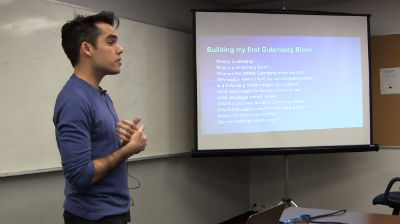
Thiago Loureiro: Building my first Gutenberg Block
WordCamp Toronto 2018Speaker: Thiago LoureiroDecember 28, 2018 — This technical session is for developers as well as users with at least a little coding experience. After a brief introduction to what Gutenberg is and what it can do, the presentation will show simple bits of code and demonstrate how these bits of code translate into a Gutenberg block.
Building a Gutenberg block is very simple
Gutenberg blocks make the editing experience a lot richer -
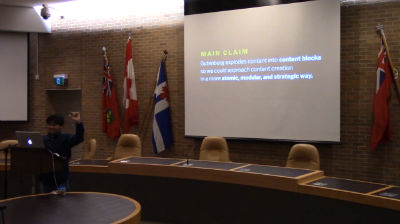
Jesse Emmanuel (Jem) Rosario: Gutenberg and the Content Design Opportunity
WordCamp Toronto 2018Speaker: Jesse Emmanuel (Jem) RosarioDecember 28, 2018 — Gutenberg’s imminent arrival creates both excitement and uncertainty in WordPress users. On the one hand, its resemblance to distraction-free editors—Medium, for example—is a step forward. On the other hand, its impact on site building is massive. Aside from whether Gutenberg will be compatible across every single WordPress site, we also wonder if it spells the end of page builders or even WordPress consulting. This session is a forum for those questions.
We’ll assess Gutenberg’s opportunities and challenges and how we might prepare for it. We’ll especially look at Gutenberg’s content design opportunity and how it enables better content creation through atomized content. By modularizing content into blocks, we have the opportunity to approach content creation from the bottom-up—something that’s more explicit in Gutenberg than in the current WordPress editor. Whatever your views regarding Gutenberg, come to this session for a nuanced look on what it has to offer and prepare for its imminent arrival.An overview of Gutenberg’s editing interface and authoring experience.
Discuss and plan for Gutenberg’s strengths, weaknesses, opportunities and threats with respect to adoption and site development.
A broad introduction to content design and how Gutenberg explicitly builds it into the authoring experience. -

Brian Rotsztein: Current Trends in SEO For Businesses and Bloggers
WordCamp Toronto 2018Speaker: Brian RotszteinDecember 28, 2018 — The basics behind search engine optimization (SEO) and high rankings in Google haven’t changed much in the last decade. While both on-site SEO and off-site SEO tactics remain important, newer areas of focus have come into play. Topics such as content quality, website speed, security, design, the Knowledge Graph, artificial intelligence, algorithm updates and Google mandated changes should be considered by anyone looking to stay up to date with SEO. This session will discuss some of the latest trends that site owners and managers should be aware of.

An  Invention
