
Language: English
-
Ben Meredith: How To Hire and Keep Remote Workers Who Rock
WordCamp Pittsburgh 2017Speaker: Ben MeredithJuly 10, 2018 — Are you looking to hire remote workers to scale your business? Want to find cream-of-the-crop developers, support reps, or others?
Ben is the Senior Support Technician at WordImpress and was their first full-time remote hire. Come to this talk to hear from the employee’s perspective how the team at WordImpress has gone above and beyond to support him and make him not just feel like a part of the team — actually make him a part of it.
This talk, geared toward WordPress agency owners and HR folks, will cover the following topics:
– The fastest way to burn out remote workers and how to avoid it.
– The one non-negotiable quality to look for in a remote worker.
– Tools to effectively manage remote employees without micromanaging them.Plus come for the one key thing you are forgetting to look for in applicants to work remotely.
-
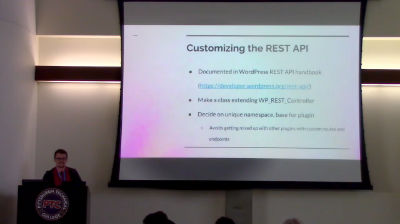
Jadon Naas: JavaScript! What is it good for?
WordCamp Pittsburgh 2017Speaker: Jadon NaasJuly 10, 2018 — Matt Mullenweg himself challenged the WordPress community to learn JavaScript deeply. WordPress is maturing into a full-featured platform for developing single-page and event-driven web applications using JavaScript and the WordPress REST API. WordPress is fully capable of supporting developers looking to add AJAX behaviors to their existing plugins, themes, and websites. We’ll examine some methodologies to deploy the REST API in event-driven applications. We’ll discuss how developers can add AJAX behaviors to their plugins, themes, or websites. For developers interested in building entire custom applications with the data management and user controls WordPress provides, we’ll talk how this can be done.
During this talk, we’ll also touch on how libraries like React.JS (Facebook) are rapidly maturing and can be utilized with WordPress for front-end application development. -
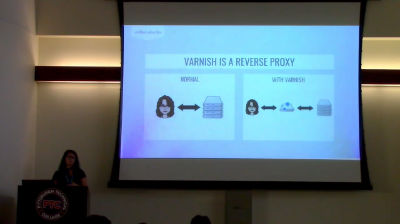
Tiffany Kuchta: Using Varnish Cache with WordPress
WordCamp Pittsburgh 2017Speaker: Tiffany KuchtaJuly 10, 2018 — Make your WordPress site fly with this one weird trick…except it’s more than one trick, and it’s only weird until you learn how it works. Varnish Cache can speed up information delivery by a factor of several hundred and earn you the coveted “A” in the TTFB column. This talk will provide an overview of Varnish Cache, what it is and how it works. Then we’ll explore setup and the ways you can integrate Varnish with simple WordPress sites before discussing more complex implementations, strategies for handling state, Edge Side Includes and other neat things Varnish does. HTTPS? Glad you asked. We’ll talk about that too.
-
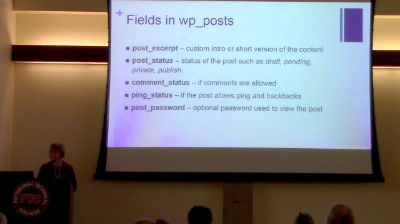
Rene Morozowich: Your New BFFs: The WordPress Core Tables + the MySQL Database
WordCamp Pittsburgh 2017Speaker: Rene MorozowichJuly 10, 2018 — You’re a rockstar with the front end and the WordPress admin, but the back end is… a mystery. Ever wonder what happens when you create a user or save a post? Where does the data go? Let’s dive in to the MySQL database via phpMyAdmin. We’ll explore the WordPress core tables and investigate the fields to see how the data is stored. We’ll also touch on optimizing your tables and creating database backups without a plugin.
-
Nara Kasbergen: Empathy As A Service: Supporting Mental Health in the Tech Workplace
WordCamp Pittsburgh 2017Speaker: Nara KasbergenJuly 10, 2018 — This talk will begin with an overview of key statistics about mental illness, followed by the efforts of the non-profit organization Open Sourcing Mental Illness to gather more data about mental health in the tech industry, the ALGEE action plan taught by the Mental Health First Aid training course, and finally conclude with ideas and strategies for making our tech workplaces more accommodating and inclusive.
-
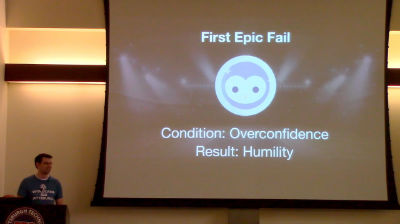
Kevin Hoffman: Succeeding In Spite of Ourselves
WordCamp Pittsburgh 2017Speaker: Kevin HoffmanJuly 10, 2018 — Have you ever wondered why the same behaviors that come naturally to some individuals are incredibly difficult for others? Many web professionals blog daily and constantly interact with the community. Others go through their entire careers in isolation and take seven years to write a single blog post. The difference lies in a combination of our beliefs and our thresholds. In this talk, I’ll recount my journey of identifying thresholds and overcoming them in order to realize the behaviors that I’ve long known needed to happen.
-

Sean Blakeley: When to use the API
WordCamp Europe 2018Speaker: Sean BlakeleyJuly 9, 2018 — As the WordPress API matures, this is an important moment to take stock and consider the best use-cases. We’ll briefly take a bird-eye view of the API, before deep-diving into different ways the API has been deployed. We’ll see an examples of the API as an integration tool for running dual CMSs, as a public-facing queryable dataset, as a big data visualisation tool and as a way to share large sets of data. Along the way, I’ll share ways to make your API implementation more efficient – and share some of the pitfalls and mistakes we’ve made. We’ll take a look at decoupling both the frontend and backend of WordPress – and answer the obvious question – why continuing using WordPress?
-

Maura Teal: The Balancing Act of Caching in WordPress
WordCamp Europe 2018Speaker: Maura TealJuly 9, 2018 — Utilizing caching mechanisms in a WordPress product is a balancing act: what remote calls are cacheable, what queries are slow and only occasionally needed, and how will it all impact the end user? In some cases we can set up our environment for a base level of performance, and in others we’ll need to balance data storage (like autoloaded options) and other background processes so they take the overall environment into consideration. I’ll be including my own experiences as a web developer working on a large-scale WordPress multisite as well as sharing the perspective from a hosting company’s point of view.
-

Adam Silverstein: JavaScript APIs in WordPress
WordCamp Europe 2018Speaker: Adam SilversteinJuly 9, 2018 — We will explore the existing major JavaScript API’s including wp.api – the bundled REST API client, wp.customize the improved JavaScript Customizer API, wp.codeEditor – the new code editor built into WordPress; wp.heartbeat – a powerful and easy client/server synchronization API; and wp.media – to leverage the media modal. We’ll also explore the future of WordPress JavaScript and look at the JavaScript APIs coming to WordPress including the APIs exposed by Gutenberg, and the WordPress npm packages including wp.hooks – JavaScript actions and filters matching the PHP versions.
-

Marieke van de Rakt: Improving your internal linking structure
WordCamp Europe 2018Speaker: Marieke van de RaktJuly 9, 2018 — If you do not structure your website neatly, your visitors will get lost and Google will get lost. You have to tell Google which posts are most important, otherwise, all of your posts will be competing for attention. In order to overcome this problem, you’ll need a kickass internal linking structure. So what can you do to avoid your site structure becoming an issue? In this talk, I will go into 5 ways to improve your internal linking structure and with it, your SEO! 1. Decide upon cornerstones 2. Link from tail to head 3. Regularly evaluate categories 4. Use tags (but not too many) 5. Identify and solve orphaned content

An  Experiment
 WordPress.tv